Research
I study algebraic topology, particularly homotopy theory, category theory, and K-theory, and the applications of these theories to manifolds. My favorite kinds of problems involve understanding topological/geometric structure using the tools of homotopy theory.
I like the way Fields medalist Maryam Mirzakhani described mathematical research: it's like “being lost in a jungle and trying to use all the knowledge that you can gather to come up with some new tricks, and with some luck you might find a way out.”
Explanation for a general audience
My research is in an area of abstract math called algebraic topology, more specifically homotopy theory.
Topology is the mathematical study of shapes — both familiar shapes like circles and cubes, and also complicated, higher-dimensional shapes that are tricky to visualize. Unlike in geometry, topologists don't keep track of rigid measurements like distance, angle, or size. Two shapes are "topologically the same" if one can be obtained from the other by squishing, stretching, or other elastic deformations. There is a classic joke that a topologist can't tell the difference between a coffee mug and a donut, because a squishy coffee mug could be molded into a donut without creating any rips or tears.

So how can we tell if two shapes are "topologically the same" or not? This is a hard question that prompted the development of many different kinds of math, each with their own techniques and tools.
In algebraic topology, we use measurements called "invariants" to distinguish topological shapes. Just as a function sends inputs to outputs, a topological invariant assigns a shape to something algebraic — like a number, a collection of numbers, a formula, or a more abstract mathematical structure. If two shapes are topologically the same, then they produce the same output. On the other hand, if two shapes give different outputs, they have to be topologically distinct. Different kinds of topological invariants have been used to understand how DNA is knotted or to extract meaning from a large data set.
Rather than using invariants as tools to study specific shapes, I like to study how the invariants themselves are constructed and to think about how to create new ones. The framework I use is called homotopy theory, which borrows a lot from a toolkit called category theory and combines intuition with a high degree of abstraction. One type of machine that shows up a lot in my research is called K-theory, which records how things decompose into smaller pieces — much like molecules decompose into atoms. This simple idea has surprisingly powerful applications in a wide variety of fields of math; check out this article I wrote about how K-theory can be linked to a geometry problem from Ancient Greece.
Explanation for mathematicians
I'm interested in how tools from homotopy theory and category theory can be used to address problems in geometry and topology. A unifying theme of my work is to understand how invariants from algebraic topology behave in the presence of symmetry.
At the heart of higher algebraic K-theory is the idea that mathematical objects can be studied by analyzing how they decompose and reassemble — a principle that arises in seemingly unrelated fields. While originally defined to capture algebraic invariants of rings, higher algebraic K-theory has since grown far beyond its initial scope to encompass increasingly rich and intricate settings. One powerful example that is particularly relevant to my work is Waldhausen's algebraic K-theory of spaces, which he developed to better understand the topology of manifolds via a space-level lift of Smale's award-winning h-cobordism theorem.
My thesis work extends Waldhausen's construction to apply to orbifolds, a generalization of manifolds which allow for certain singularity points. Orbifolds arise naturally in many areas of mathematics and physics, but there is still much to be understood about how to extend important manifold techniques to this setting. Part of my research program is the development of tools to study orbifolds, using the perspective of modern homotopy theory and higher algebra.
The techniques I use in my research draw on and contribute to the field of equivariant algebraic topology, an area that has seen remarkable advances in recent years driven by the resolution of the famous Kervaire Invariant One problem and the disproof of the Telescope Conjecture. My coauthors and I have studied versions of K-theory that take symmetry into account, extending classical tools to new contexts where group actions play a key role. Beyond K-theory, my work in equivariant homotopy theory provides foundational computations in equivariant algebra and investigates how classical algebraic structures generalize to the equivariant setting.
Another thread of my research translates the principles of algebraic K-theory to produce invariants of manifolds based on how they decompose into smaller pieces. This work is situated within scissors congruence K-theory, which is an emerging research program inspired by scissors congruence of polytopes and Hilbert's 3rd Problem. I am broadly interested in studying these new K-theory constructions from a categorical perspective and investigating how they can be applied to new kinds of objects, such as graphs.
Publications and preprints
- On the classifying space of a Morse flow category (with Fangji Liu). Available on arXiv.
Summary
We show that the classifying space of a Morse function f on a smooth, closed manifold M recovers the homotopy type of M, as long as the gradient flow is suitably "tame" (just meaning that the compactified moduli spaces of broken gradient trajectories are locally contractible). We show that this tameness assumption is crucial by constructing a Morse function and Riemannian metric on S2×S1 for which the associated flow category fails to recover the correct homotopy type.
This paper addresses a gap in a preprint of Cohen-Jones-Segal, and finally finishes the work I started in my undergraduate thesis!
- A comparison of definitions of equivariant trees (with Julie Bergner, David Chan, Angélica Osorno, and Maru Sarazola). To appear in the Proceedings of the 2024 Mathematics Research Community on Homotopical Combinatorics. Available on arXiv.
Summary
One of the models of operads uses the dendroidal category Ω, which is a certain category of trees. Recent work on genuine equivariant operads introduces an analogous category ΩG, whose objects can be understood as trees with H-action for varying H≤ G. This paper studies these categories of trees and shows that they can be modeled by Grothendieck constructions on categories of trees with a fixed set of leaves. - A genuine G-spectrum for the cut-and-paste K-theory of G-manifolds (with David Chan). Bulletin of the London Mathematical Society, Vol. 58, No. 4: e70352 (2026). Also available on arXiv.
Summary
Given two d-dimensional manifolds M and N, one can ask whether it is possible to cut M up into pieces and reassemble these pieces in a new way to obtain N. This “cut-and-paste” relation, also known as an SK-relation (which abbreviates the German translation schneiden und kleben for cut-and-paste), also makes sense in the equivariant context. A recent paper shows that the equivariant SK-groups arise as the zeroth K-groups of squares categories, and moreover these SK-groups assemble into a Mackey functor. They conjecture that this Mackey functor arises as the zeroth homotopy Mackey functor of a genuine G-spectrum, and the main result of our paper is to prove this conjecture. We do so by giving a general procedure for constructing genuine G-spectra (as spectral Mackey functors) using squares K-theory. - Segal K-theory factors through Waldhausen categories (with David Chan). Proceedings of the American Mathematical Society, Vol. 154, No. 10, p. 4149-4166 (2026). Also available on arXiv.
Summary
There are various different K-theory machines that take in different kinds of categorical inputs, and it is helpful to know when and how these constructions are comparable. For instance, the K-theory of an exact category (built using Quillen's Q-construction) can always be modeled using Waldhausen's S-dot construction. This paper provides a similar comparison for Segal's K-theory of symmetric monoidal categories: given a symmetric monoidal category, we construct a Waldhausen category with an equivalent K-theory spectrum. As a consequence, we obtain a version of Thomason's theorem, namely that every connective spectrum is equivalent to the K-theory of some ordinary Waldhausen category. - The spectrum of the Burnside Tambara functor (with David Chan, David Mehrle, J.D. Quigley, Ben Spitz, and Danika Van Niel). International Mathematics Research Notices, Vol. 2026, Iss. 2, paper no. rnaf388 (2026). Also available on arXiv.
Summary
We compute all the prime ideals of the Burnside Tambara functor on a finite group. Our work leverages a "lying over theorem" for Tambara functors to show that the prime ideals that Sam and I identified are all the possible prime ideals.
Check out slides for a talk (~40m) which I presented at the eCHT research seminar (2026).
- Squares K-theory and 2-Segal spaces (with Maru Sarazola). Annals of K-Theory, Vol. 11, No. 2, p. 261-308 (2026). Also available on arXiv.
Summary
We show that when a squares category (which is a special kind of double category) looks like it came from a Waldhausen category, then its squares K-theory construction can be modeled by a version of the S•-construction. Moreover, when the input category is suitably "stable", this S•-construction produces a 2-Segal space. - Equivariant algebraic K-theory of symmetric monoidal Mackey functors (with David Chan and Maximilien Péroux). Available on arXiv.
Summary
This paper revisits work of Bohmann–Osorno on the K-theory of categorical Mackey functors. We show that every symmetric monoidal Mackey functor (in the sense of Hill–Hopkins) may be strictified to a categorical Mackey functor (in the sense of Bohmann–Osorno). Along the way, we resolve some technical issues in the original paper of Bohmann–Osorno and prove a version of the Guillou–May theorem for covariant (as opposed to contravariant) spectral Mackey functors. - A linearization map for genuine equivariant algebraic K-theory (with Andres Mejia and David Chan). To appear in Algebraic & Geometric Topology. Also available on arXiv.
Summary
The linearization map relates the Waldhausen A-theory of a space X to the K-theory of the group ring ℤ[π1(X)] and plays an important role in computations. When X has an action by a finite group G, Malkiewich–Merling have constructed a genuine equivariant A-theory spectrum for X. In this paper, we construct the equivariant analogue of K(ℤ[π1(X)]) which is the target of an equivariant linearization map.
Check out the user's guide for this paper or slides for a talk (~20m) which I presented at JMM (2024).
- Nested cobordisms, Cyl-objects, and Temperley-Lieb algebras (with Renee S. Hoekzema, Laura Murray, Natalia Pacheco-Tallaj, Carmen Rovi, and Shruthi Sridhar-Shapiro). Topology and its Applications: Vol. 376, no. 109448 (2025). Also available on arXiv.
Summary
Our paper defines a nested cobordism category whose objects nested manifolds — which can be thought of as manifolds with embedded submanifolds (which may themselves have embedded submanifolds, and so on) — and nested cobordisms between them. We study this category with an eye towards the celebrated folklore theorem that identifies 2-dimensional TQFTs with Frobenius algebras.
Check out slides for a talk (~50m) which I presented at the TQFT club seminar (2026).
- A combinatorial K-theory perspective on the Edge Reconstruction Conjecture in graph theory (with Julian J. Gould). Homology, Homotopy and Applications: Vol. 27(1) (2025). Also available on arXiv.
Summary
The Edge Reconstruction Conjecture asks whether a graph is determined by its multiset of "edge-deleted" subgraphs. In this paper, we rephrase this reconstruction problem using a K-theoretic framework. Our work — while not proving (or disproving) any part of the conjecture — opens up new avenues for exploration, both K-theoretic and combinatorial.
Check out slides for a talk (~20m) which I presented at BUGCAT (2024).
- Equivariant Trees and Partition Complexes (with Julie Bergner, Peter Bonventre, David Chan, and Maru Sarazola). Theory and Applications of Categories: Vol. 45, 2026, No. 15, p. 501-536 (2026). Also available on arXiv.
Summary
Given a finite set, the collection of partitions of this set forms a poset category under the coarsening relation, and this category is directly related to a space of trees. In this paper, we explore several possible generalizations of these objects to an equivariant setting, where the finite set comes equipped with a group action.
Check out slides for a talk (~20m) which I presented at BUGCAT (2022).
- The Spectrum of the Burnside Tamara Functor of a Cyclic Group (with Sam Ginnett). Journal of Pure and Applied Algebra: Vol. 227, Iss. 8 (2023). Also available on arXiv.
Summary
We determine a family of prime Tambara ideals in the Burnside Tambara functor on a finite group G. When G is cyclic, we show that this family comprises the entire prime ideal spectrum of the Burnside Tambara functor.
Check out slides for a talk (~20m) which I presented at JMM (2024).
- The Tambara Structure of the Trace Ideal (with Sam Ginnett). Journal of Algebra: Vol. 560 (2020). Also available on arXiv.
Summary
We study the kernel of the Dress map as a morphism from the Burnside Tambara functor to the Grothendieck-Witt (Galois) Tambara Functor. In certain cases, we can explicitly determine the generators of this kernel as a Tambara ideal.
Check out slides for my talks about this paper: a long version (~50 min) presented at the Reed College Student Colloquium (2020) and a short version (~15 min) presented at the Nebraska Conference for Undergraduate Women in Mathematics (2020).
- Sharp Sectional Curvature Bounds and a New Proof of the Spectral Theorem (with Corey Dunn). Involve, a Journal of Mathematics: Vol. 13, No. 3 (2020). Also available on arXiv.
Summary
We compute and bound the possible sectional curvature values for a canonical algebraic curvature tensor, and geometrically realize these results to produce a hypersurface with prescribed sectional curvatures at a point. We also give a relatively short proof of the spectral theorem for self-adjoint operators on a finite-dimensional real vector space.
- k-Plane Constant Curvature Conditions. Rose Hulman Undergraduate Journal of Mathematics: Vol. 20, Iss. 2 (2019).
Summary
Constant sectional curvature and constant vector curvature are two curvature invariants of an algebraic curvature tensor which take in 2-planes as input. We generalize these invariants to take k-planes as input and explore their structure. Just as in the k=2 case, we show that a space with constant k-plane scalar curvature has a uniquely determined tensor and that a tensor can be recovered from its k-plane scalar curvature measurements.
Check out slides for a talk (~20 min) which I presented at various undergraduate symposiums circa 2018.
Theses
- Algebraic K-theory of orbispaces. Ph.D. thesis (2026) supervised by Prof. Mona Merling. Here’s an explanation of my thesis for a general audience and for mathematicians, and here are the slides from my defense (~30min).
- An Introduction to Symplectic Geometry for Lagrangian Floer Homology. Expository master’s thesis (2022) written as part of my Ph.D. qualifying exam, supervised by Prof. Jonathan Block.
- Morse Theory and Flow Categories. Reed College undergraduate thesis (2020), advised by Prof. Kyle Ormsby. Disclaimer: there are some errors in the later sections. Here’s a blog post about what went wrong.
Expository writing and slides
- Orbispaces as stacks: geometry and examples. Write-up for a talk at the Moduli spaces of pseudo-holomorphic curves workshop (May 2025).
- Cyclotomic spectra. Write-up for a talk at the Hot Topics: Life after the Telescope Conjecture workshop at SLMath (December 2024).
- The scissors congruence K-theory of polytopes is a Thom spectrum. Write-up for a talk at the Scissors congruences, algebraic K-theory, and Steinberg modules workshop at AIM (Summer 2024).
- Looking into Mirror Symmetry at the 2024 JMM. Feature story in News from the AMS (February 2024).
- Square K-Theory and Manifold Invariants. Write-up for a talk at Talbot 2022: Scissors Congruence and Algebraic K-theory (Summer 2022). Check out the slides for my presentation (~50min).
- Notes on Waldhausen's higher algebraic K-theory. These are notes that came out of preparing for my PhD qualifying exam (Spring 2022). Read at your own peril.
- Notes on classifying spaces of topological categories. Some notes about classifying spaces of categories and what happens when that category comes with extra topological structure. Some of this was adapted from my undergrad thesis (Spring 2020), some was written in preparation for my PhD qualifying exam (Spring 2022), and some of it is just for fun.
- A Bit About Infinite Loop Spaces. An expository overview of infinite loop space theory written for Math 619: Algebraic Topology I (Spring 2021) at UPenn, with Prof. Mona Merling. Check out the slides for my presentation (~25min).
- Freudenthal Suspension Theorem. Supplementary write-up to presentation for the Algebraic Topology Bridge Summer workshop (Summer 2020). Check out the slides for my presentation (~50 min).

Slides from other expository talks
- How to cut up shapes using algebraic topology (~10m), presented at the UPenn graduate student open house (Spring 2025).
- Social choice problems and algebraic topology (~10m), presented at the UPenn graduate student open house (Spring 2024).
- The Stable Parametrized h-Cobordism Theorem: the K-theory part (~30m), presented at the online seminar leading up to the Spaces of Manifolds: Algebraic and Geometric Approaches BIRS workshop (Fall 2023).
- Equivariant Bundle Theory and Classifying Spaces (~50m), presented at eCHT's equivariant homotopy theory reading seminar (Fall 2021).
- Bousfield Localization (~50min), presented at UPenn's chromatic homotopy theory seminar (Summer 2021).
- Topological K-theory (~50min), presented at Algebraic Topology Bridge Summer Workshop (Summer 2021).

See more misc. stuff
- Lens space: a CW story video I made for Math 810: Video Production for Mathematics seminar (Fall 2021) at UPenn, taught by Prof. Rob Ghrist.
- How to write mathematics badly (transcript). A (somewhat incomplete) transcript of this public lecture given by Jean-Pierre Serre.
- I have a running page of fun outreach activities related to geometry/topology.
From undergraduate:
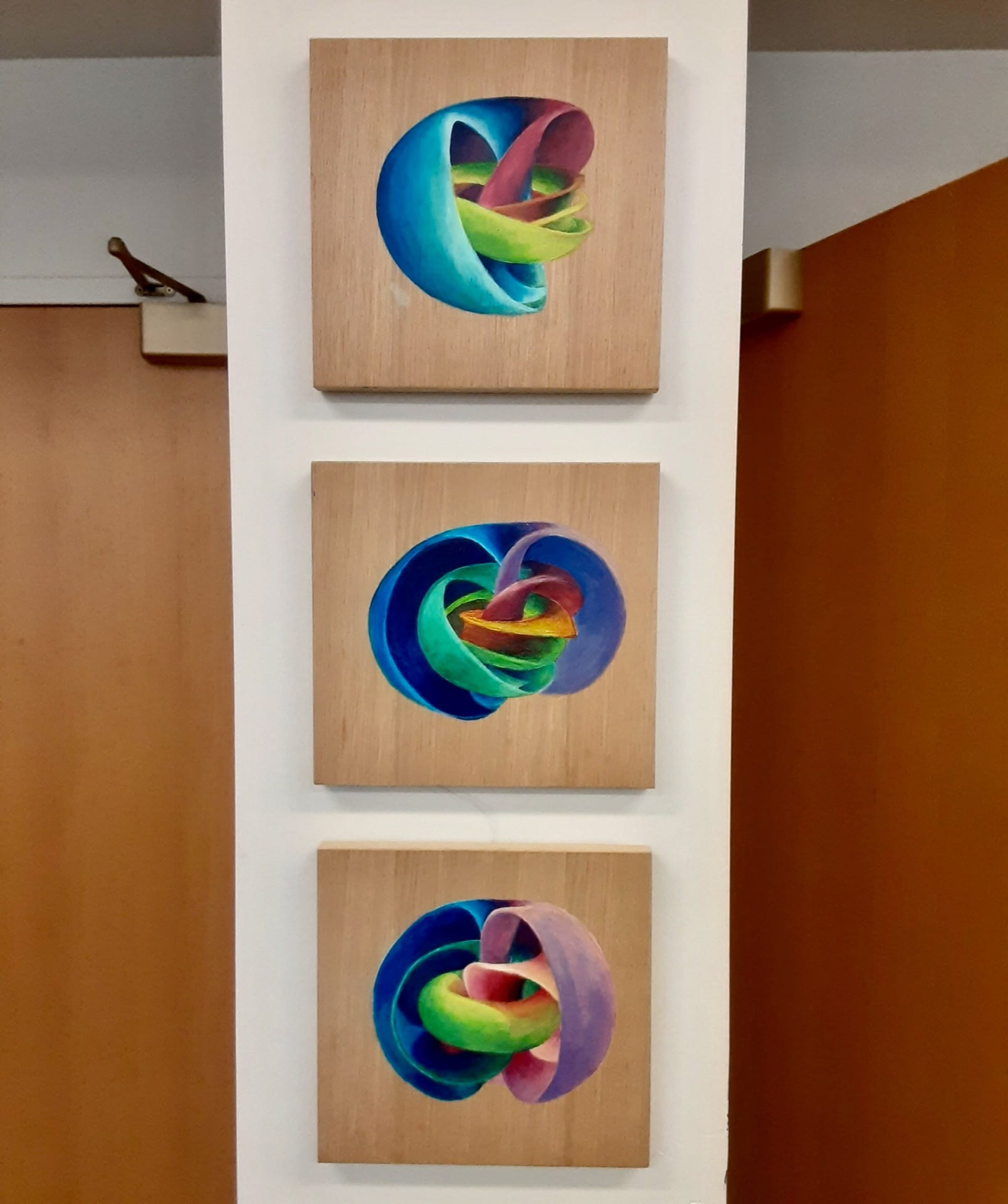
- I did some paintings of the Hopf fibration (inspired by this video by Niles Johnson) which I hung up in Reed's math lounge.
- Configuration Spaces and Robots video, with Lucas Williams. We submitted the video to the Elevating Mathematics Video Competition and received an honorable mention. The video was inspired by this paper by Williams, completed under the supervision of Prof. Safia Chettih.
- Gauss' Class Number Problems and the Determination of Imaginary Quadratic Fields with Class Number One. For Math 361: Number Theory (Spring 2019) at Reed College, with Prof. Jerry Shurman.
- On the Flipside: Refinements of Polytopal Subdivisions and Secondary Polytopes. For Math 341: Topics in Geometry, Polytopes (Fall 2018) at Reed College, with Prof. Angélica M. Osorno.
- A Case for Quotienting: Equivalence and Postmodal Mathematical Structuralism. For Phil 411: Advanced Topics in Metaphysics, Metaphysics of Science (Fall 2018) at Reed College, with Prof. Troy Cross.